
On Tuesday night, two US politicians will talk and then some media experts will talk about what the politicians talked about. Polls suggest that the country is nearly split 50/50 about which politician is preferred. For media companies, that is great news: they can say “Stay tuned for the latest news on this small but dramatic change”. But treating elections as a horse race does little to inform the public about the problems of a nation or possible solutions. It is also inaccurate.
In a simple election, there are two outcomes: Party A wins or Party B wins. You may think that Party A is more likely to win. You may even know enough economics to know the best fiscal and monetary policies and your personal preferences may be to have Party B win.
Election markets focus on different questions: “How likely is it that Party A will win?” and, more importantly, “Are you willing to put your money where you mouth is?”
A typical election market “share” for Party A pays $1 if Party A wins the election and $0 if Party B wins. If you believe that the likelihood that Party A will win is 60 percent and the current price of a share in Party A is $0.50, then buying one share of Party A represents an expected profit of $0.10. You could buy more than one share.
These markets interest economists because, in theory, market forces aggregate a lot of information. A competitive market is decentralized with many potential buyers and many potential sellers, each of whom know something but not everything. Yet, in a well-organized market, there is only one market price. You may believe that the probability that Party A will win is 60 percent but somebody else may disagree with you.
In a market, every transaction requires a buyer and a seller. Therefore, if $0.50 is the current price and you buy a share at $0.50 then there must also be a willing seller at that price. They are selling because they expect to profit: they think that the likelihood that Party A will win is less than 50 percent. So, both of these people profit (in an expected sense) by buying and selling shares. The answer to “Who is right?” will be determined shortly after election night.
It is also true that the market price of a share might change, due to news. News does not change the number of winners or the number of losers but a report on a new poll of voters or performance in a debate can change the price of a share.
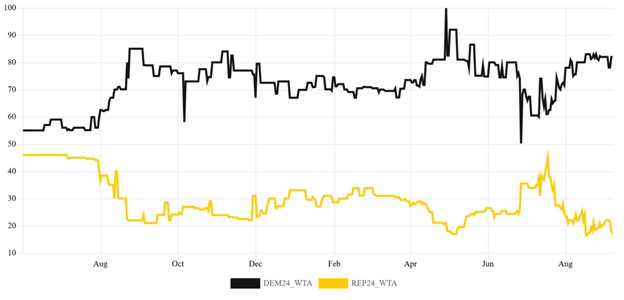
At a share price of over $0.80 (as of Sept. 8, 2024), the Iowa Election Stock Market is saying that the probability that Democrats will win the Presidency in the 2024 election is over 80%. That number is not a “95% sure thing”, and it may change in the future, but it is very different from 2 months ago and very different from the media’s suggestion of a 50/50 horse race.
If you are thinking that financial stock markets work in the same way then you would be right. You may also think that stock markets are risky and that risk in election stock markets could be a concern. There is a simple solution: the cost of risk is an issue only if you are investing at scale. It is also true that risk is costly only if you are unsure of the likelihood that Party A will win.
In a disagreement amongst pundits talking on TV, each could argue at great length about why they are right and the other person is wrong. It might be entertaining. Some work shows that pundits may be more entertaining than accurate. Election markets impose a penalty on pundits who talk insincerely and the possibility of profit encourages everybody to respect the data.
By the way, betting $1 on Conservatives in Canada (and they win) produces a payoff of $1.12 (as of Sept. 8, 2024) while betting $1 on Liberals (and they win) produces a payoff of $5.00. So, the profit maximizers at Bet365 think that the odds that the Liberals will win must be lower than the odds that the Conservatives will win. This difference in odds differs from each party’s share of the popular vote, according to the polls.
Now, it is your turn to write.
There is more than one prediction market which allows you to try to make money from betting on an election: PredictIt and the Iowa Election Stock Market (“Winner Take All” market) seem to be the two biggest (i.e., most liquid). Betting companies, such as BET365 allow people to place a bet at odds set by the company. With more than one source, it is possible that different sources imply a different probability that your favourite candidate would win. Those differences create the possibility of arbitrage profits. Unlike the risk associated with picking one of the possible candidates, arbitrage profits are riskless (except for the time it takes to buy in one market and then sell the same thing in a different market).
Suppose that you have $1000 to invest in these three sites. Divide the money between the three sites equally and buy a riskless portfolio: if you buy equal shares of Republican win and Democratic win then you are guaranteed to win $1 regardless of who wins).
- Imagine selling some shares on one site and using all of that money to buy the same type of share on a different site. Do you end with more or less? Which site gives the best payout if you are 100% sure that the Republican party will win? Which site gives the best payout if you are 100% sure that the Democratic Party will win?
- Since different stock markets and betting sites use different language to talk about payouts, use algebra to identify when no arbitrage profits exist: i.e., state a condition which implies that there is no sequence of trades which produces excess profit.
- The previous question is a bit imprecise since there is usually a “bid-ask spread”: i.e., the price at which you buy is not exactly the same as the price at which you sell. You could answer the third question by using the average of the bid price and the ask price. That would be instructive. You could also try to answer the question while accounting for the bid and ask for each type of trade. Is the bid ask spread big enough to remove all of the excess profit from attempting to arbitrage?
 5 Basic Principles of Economics
Leave a comment