People in Canada are thinking about the tariffs, retaliatory tariffs, reciprocal tariffs and threats of more from the US. There was a time before and, eventually, markets will adjust to the time after. The challenge is to manage the time in between. The media focus on layoffs and, until other buyers can be found, production decisions. More subtle and instructive responses are being overlooked.
While politicians negotiate, business people have to act in order to avoid being hurt (too much). Traditionally, businesses use inventories to buy time and manage risks. Ideally, a car maker using a just-in-time process holds just enough parts that the last one in the warehouse is fitted onto the car when the next delivery of parts arrives. They might hold a bit more, since traffic congestion can delay a delivery, but inventory is costly.
So, it is not surprising that some companies are ordering more intermediate inputs than needed. Warehouses are being filled [1] [2] [3] [4]. My guess is that, in order to reduce the effect of the tariffs, some cross-border deals are being negotiated to give some customers earlier shipping times.
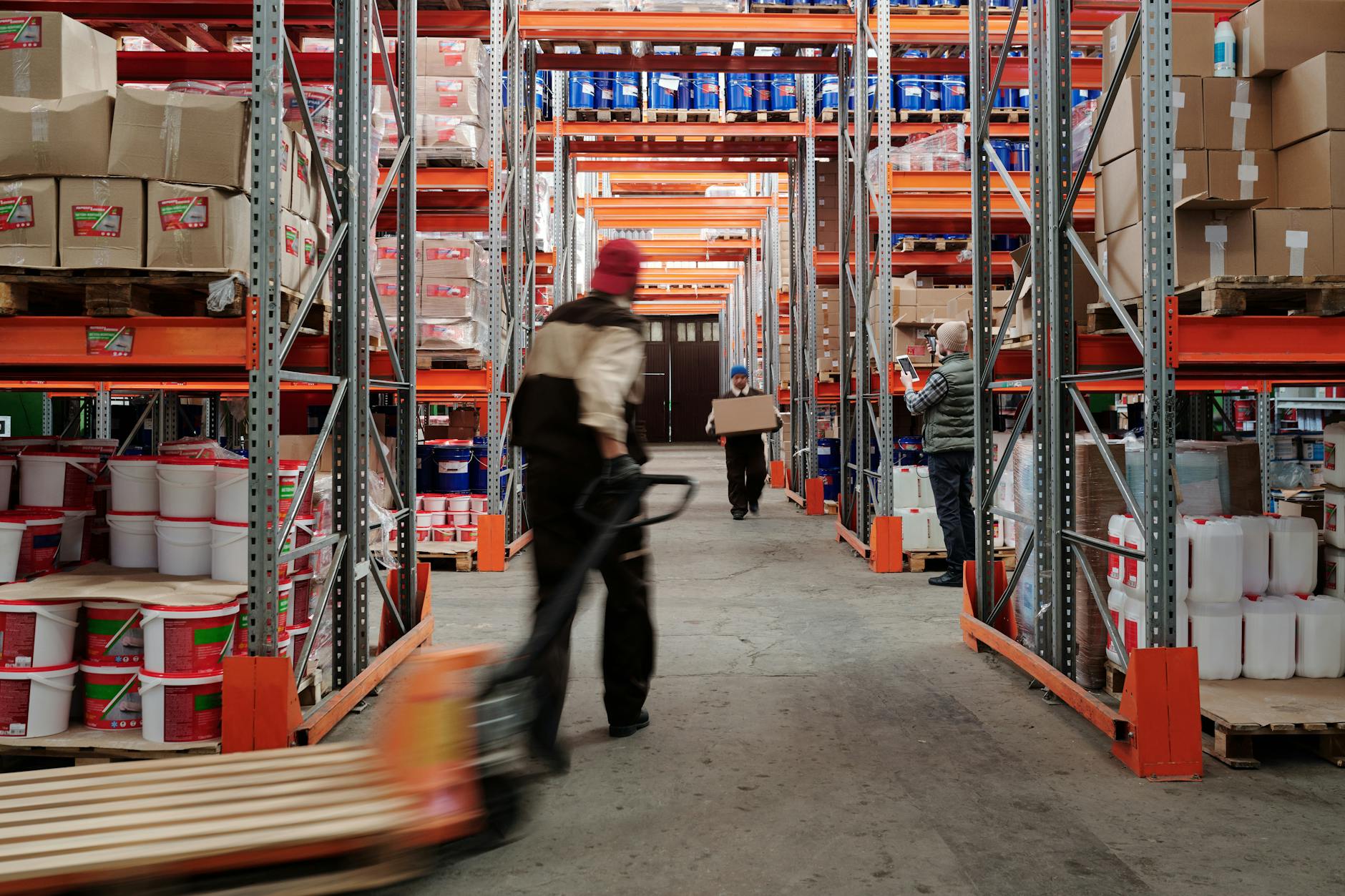
In other words, businesses are using time and inventories as margins of adjustment. Using the language of an economics textbook, inventories make the “short run” last a little bit longer and reduce the costs of transitioning to the “long run” outcome.
At the end of this week, Statistics Canada Daily will publish data on inventories held by manufacturers for January 2025 [1] [2]. It will be interesting to look at. Looking at the data from February or March will be even more interesting.
The possibility of holding inventory also reveals an interesting difference between “goods” markets (i.e., tangible things, such as cars, computers or apples) and “services” markets (intangible things, such as a getting a haircut, eating at a restaurant or tourism). Textbooks treat them similarly, since the the logic of supply and demand applies to both. But “similar” is not “same”: different markets react to external forces differently both in appearance and in scale. As a simple example, apples and oranges are more perishable than apple juice and orange juice. So, the relevant short run for apples and oranges includes fewer months than the relevant short run for juices.
Services differ in many ways. It is hard to ship a “vacation to Banff” from Alberta to Florida, regardless of tariff policies. The hotels and restaurants offering services in Banff have trouble deciding how many workers to hire during the peak season. If idle, they cannot ask workers to create an inventory of clean rooms for the guests who will visit in the future. Similarly, the person giving you a haircut needs to wait for you before they can start to work.
Finally, media reports offer a complementary validation of economic theory. Apparently, steel and aluminum manufacturers in the US started to raise their prices even before the tariffs took effect [1] [2]. This fact shows why economists argue that tariffs do not “create” jobs: tariffs raise the market price in some locations, which “creates” jobs in some industries and “destroys” other jobs elsewhere.
Now, it is your turn to write.
- If the price of the aluminum used in cans increases, how will Coca-Cola and Pepsi react?
- If you were negotiating for US Steel and talking with an existing client located in the US, how would you justify the price increase? The client is likely to argue “The tariffs should have no effect on our deal. We already buy our steel from you and the tariffs did not increase your costs.”
 5 Basic Principles of Economics
Leave a comment