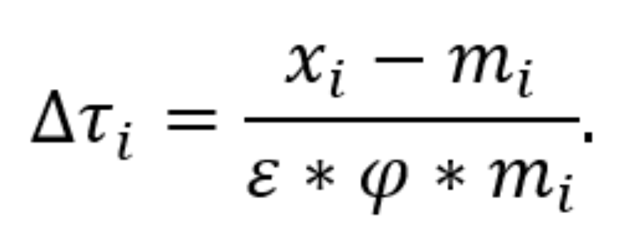
On April 2, 2025, President Trump displayed a poster which listed countries and the “reciprocal” tariffs to be imposed on their imports quickly. Reporting by CNN and others shows that the numbers are justified by this formula.
Many media noted how amazingly stupid this formula is. Arithmetic errors are embarrassing, if you are in Grade 3. Adults using a formula which has a five trillion dollar effect within 48 hours requires a special kind of silliness. Any formula with an effect this big should be studied carefully, and this short post shows that doing so reveals five problems of analysis.
The formula claims to answer this question: “find a tariff rate (i.e., ∆τ) on imports (m) that would cause the trade deficit (x- m) to equal zero”. (Ignore the notation i which refers to different countries.) ∆τ affects imports (m) and, since tariffs are expressed as a percentage, that effect is summarized by an adjusted elasticity: ε φ, whose value has been measured by others (but see note below). So, the relevant math is: find ∆τ such that
(∆τ) ε φ m= x- m.
With one unknown and one equation, algebraic manipulation reveals the published formula.
The algebra is correct. Consider the case of China, with 67%: since x= $143.5b, m= $438.9b and ε φ is said to be about 1. Using those numbers produces ∆τ= 67% (after rounding). Double-checking (always a good idea when doing arithmetic): a 67% tariff decreases imports by 67% ε φ= 67% 1= 67%. 67% of $483.9b is $294b, which equals x- m.
Since insightful economics applies mathematics as a tool, does this algebra answer a relevant question? High school math classes teach that most functions are not linear. Since this equation asserts that the effect of ∆τ is linear, you should wonder whether the consequences of non-linearity, especially if the proposed solution for ∆τ is 25%, 50% or 90%. Second, this mathematics uses assumptions which are inconsistent with other claims made by the White House: the formula assumes that imports fall because the prices of imported goods rise. Inconsistencies lead to bad decisions.
The formula also fails two tests of logic: the apples and oranges test and the market test.
Apples and Oranges
The formula is justified by the assertion that “persistent trade deficits are due to a combination of tariff and non-tariff factors”: i.e., the US tariffs offset factors which reduce US exports to other countries. These factors exist. In a stereotypical display of innumeracy, the second story on listed on the FoxNews website (afternoon of April 3, 2025) focused on an example: the “300% tariff on American butter and cheese” imposed by Canada. Consider this as an “apple” worthy of being targeted.
But, they are not the whole story: some fruits are “oranges”. Persistent trade deficits in goods (note: not goods and services!) can also be caused by comparative advantage and by an imbalance between national borrowing vs. national savings.
Implementing a policy which ignores the differences between apples and oranges is guaranteed to cause collateral damage. The phrase “unintended consequences of a policy” is inappropriate because this formula is so obviously silly.
Market Test
The logic of this test is simple. If using this formula were a good idea then everybody should use the same rule all of the time. If everybody used it, would the outcome be good?
Implementing the formula broadly implies that reciprocal tariffs would be zero if and only if every country has neither a deficit nor surplus in traded goods with every other country. If country A has a deficit then the formula says that it should impose reciprocal tariff. If country A runs a surplus with country B then country B runs a trade deficit with country A: B should impose reciprocal tariffs. Such obvious barriers to trade should lead country A to retaliate. And so on.
This outcome is not good, for reasons discussed in a classic mathematical example concerning the gains from trade due to comparative advantage. If a seemingly-sensible formula fails the market test then you should ask “why did it seem sensible?” What is missing?
Note: The formula is justified, in part, by citing academic literature. So, it is noteworthy that an author of one of the cited papers says their work is misunderstood: the adjusted elasticity (ε φ) should be four times larger. This difference reminds me of an adage: “You are entitled to your opinion. But you are not entitled to your own facts.”
While economics can seem complex, especially when people make it seem complicated, this formula should not intimidate. In this case, thinking critically shows that the numbers on Trump’s poster claiming to be “Tariffs charged to the U.S.A.” are clearly not.
Now, it is your turn to write.
- James Surowiecki seems to be the first person outside of government to notice this formula. His book The Wisdom of Crowds is worth reading.
- The “Most Favored Nation” principle allows a given country to set any level of tariffs so long as it does not discriminate between countries. Trump’s reciprocal tariffs violate this principle. Does the US benefit in this case?
- What should the reciprocal tariff be for China if εφ= 1 is replaced by εφ= 4?
 5 Basic Principles of Economics
Leave a comment